books and cleverness
I read books of all sorts, but mostly kids' lit and young adult literature and speculative fiction for all ages—usually from a feminist perspective.
I've adopted a personalized version of the CHOICE reviews approach to recommendations/star ratings:
***** = Essential, a.k.a. truly love, absolute must-read, buy it now
**** = Highly Recommended, a.k.a. this is a really good book; I would buy it as a gift
*** = Recommended, a.k.a. pretty good; worth reading
** = Optional, a.k.a. meh
* = Not Recommended; a.k.a. this is not a good book

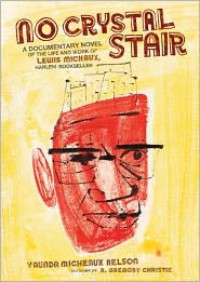
No Crystal Stair: A Documentary Novel of the Life and Work of Lewis Michaux, Harlem Bookseller
What is there to like?
The subject, Lewis Michaux, and the role he and his bookstore played in the civil rights movement and 20th-century black culture and history are well worth learning about, and this book does a fine job of bringing greater attention to Michaux's work, presenting it in an easy-to-read package. The inclusion of federal documents, newspaper clippings, and photographs from the time are an interesting glimpse through history, and bring it to life.
What's not to like?
Considered as a book in its own right, apart from the worthiness of its subject and ultimate purpose (which is difficult to do), I find it to be a bit flat. What I mean is this: it's constructed as a sort of scrapbook, with short diary-type passages written by the author from the perspective of Michaux and the people who moved through his life, interspersed with the photos and documents mentioned above. While the scrapbook structure is entertaining and I very much like the idea of including perspectives from many people to help create a sense of the true extent of Michaux's influence, the text of the book, unfortunately, is rather flat. The voices are fairly undifferentiated, consistent almost to uniformity in expression and even sentiment. And while the text does inform, the segments are so brief that they don't really engross the reader.
So, overall, considering that the book bills itself as "a documentary novel," I would sum up my response to it by saying that as a documentary it's great, but as a novel it is just so-so.
What made me pick it up?
It appeared on Elizabeth Bluemle's Shelftalker post, 2012 Starred Reviews (which is a great resource and you should definitely check it out if you are interested in finding out more of the great kids' and YA books that came out last year), and for personal reasons I'm in the process of checking out books from Carolrhoda Lab's list.
Overall recommendation: Recommended


House Held Up by Trees
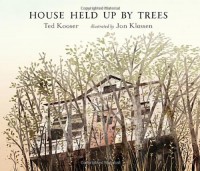
Hm. Reading along, enjoying it quite a bit, finding it quite lovely, and then--it ended. Klassen's illustrations are beautiful, of course. I love the way the boy's, girl's, and father's faces are never quite shown.The book premise is lovely, and Kooser captures the loneliness of an abandoned house as well as that of the father whose children are grown and moved on. I just feel rather let down that the book ended with the "house held up by trees," rather than being about it.

A Monster Calls

What is there to like?
▪ Throughout the book, Conor experiences some dark emotions…shame, emptiness, a need for destruction, and especially anger—towards himself, others for alienating him, the school bully, and his family—and also deep, deep sorrow. But the reader is swept up in Conor’s feelings and experiences them with him—there’s never a distance that makes the reader fear or disconnect from Conor, which is really important for finding the real strength of this story. Patrick Ness has done an outstanding job of capturing powerful, true emotions in an empathetic protagonist.
▪ Illustrator Jim Kay's art is every bit as much a part of the storytelling as the words, and it is dark and rich and textured and evocative, and worth poring over.
▪ The stories-within-the-story device is pretty commonplace, and readers may share Conor’s initial skepticism at first—but these stories are unexpected, and quickly prove their value.
▪ Excellent, true-to-life cast of characters in Conor’s go-get-’em grandmother, distant father, the school faculty who handle him like an exotic, fragile object they’re not sure what to do with, and the “bully with charisma and top marks” who will “probably end up Prime Minister one day. God help us all.”
▪ The personification of the monster through his language, stories, and the art—and the eventual blurring of Conor with the monster, also make this book memorable.
▪ This is a book that you need to pick up with your hands and read. Everything about the design is gorgeous—from the art itself to the way the art spreads across the page and mingles with the text to the unusual trim size to the weight of the book in your hand. It’s a beautiful book that exemplifies how tactile and visual components of design contribute to the reading experience.
What's not to like?
There's really nothing that I didn't like about the book itself, but Sara raises a good point about audience that I was wondering about as well.
Similar To:
The Pricker Boy, Reade Scott Whinnem
The Book of Lost Things, John Connolly
Gossamer, Lois Lowry
The Graveyard Book, Neil Gaiman (in that the art reminded me of Dave McKean’s, at times)
What made me pick it up?
It’s been on my to-read list for ages, and I saw it on the library shelf when I was picking up another “N” author.
Overall Recommendation: Essential reading. This is one of the most powerful, well-crafted books I’ve read in quite a while.
 - )
The False Prince (Ascendance Trilogy Series #1)

What is there to like?
▪ By far the best thing about this book is the protagonist, Sage—a smartmouthed, one-step-ahead-of-everyone, street urchin type. (And who can resist them? Not this reviewer.)▪ Quick-moving plot
▪ The dynamic of the relationship between the three boys—competitors but also, thanks their similar backgrounds and constant closeness, something bordering on friends—is interesting to see play out, and contributes a lot to the tension of the novel, especially in watching Sage outmaneuvering the other two.
▪ Though there are only a couple of ladies in this book, Imogen and Amarinda, they are characters rather than romantic objects.
▪ Nielsen does a nice job of narrative balancing: allowing us into the protagonist's head enough that we know there's more to the story than Sage is letting on (either to us or the other characters in the story), and keeping just enough hidden that we're not quite sure what it is (though some may guess).
What's not to like?
▪ The villain is one-dimensional and the extent of his villainy is easier to spot than I think it is supposed to be.
▪ The master/doting-servant relationships are a little uncomfortable-making, between Sage & Errol and Sage & Mott, in particular.
▪ Sage is a delightful character, but I never really felt he would make a particularly good king—which I find to be a problem because, beyond the fact that it’s his birthright, should we really be cheering for him to take the throne? Admittedly, the self-doubt that Sage/Jaron himself feels on that point is certainly a key point of the book. But in the end I wasn’t won over by the strength of his character as a potential leader, as I’ve been by other heroes…which makes the ending feel a bit less of a triumph.
Similar To:
The Queen’s Thief Series, by Megan Whalen Turner: The Thief, The Queen of Attolia, and The King of Attolia
The Amulet of Samarkand (and the rest of the Bartimaeus Trilogy), Jonathan Stroud—if you’re looking for a quick-witted, street-smart protagonist
Taran Wanderer (The Chronicles of Prydain), Lloyd Alexander—if you’re looking for a story about an ordinary boy with a greater destiny. And swords.
The Sword in the Stone, T.H. White
What made me pick it up?
It was on my to-read shelf probably because of a positive review I read, but more proximally, I kept seeing it on the shelf when I went to look for A Confusion of Princes
by Garth Nix (which I still haven’t found at the library), so it’s been more on my radar than it might have been otherwise. Also, I believe one of my Goodreads friends liked it, and also also, I’ve seen that the next one (The Runaway King) is coming out soon, so I needed to read this one before the second one comes out.
Overall Recommendation: Recommended/Highly Recommended (3.5 stars)
Disclaimer: This reminded me quite a lot of The Thief, by Megan Whalen Turner, one of my very favorite books, and I’m not sure how that affects my opinion of this book. It seems like of course it would be good that it’s similar to a book I think so highly of…but on the other hand, I admit to thinking, “Well, but it’s not The Thief…” as I was reading it. So I’m not quite sure how to “rate” this book. But I would recommend it for you to read it and decide for yourself.

Never Fall Down

The usual questions driving personal reviews—did you like this book; what did you like/not like about it; why did or didn't you—must, I feel, be dispensed with in this case. There are two questions I do feel are worth asking:
First, is the book worthwhile of its topic?
And the answer of course is yes. To explain the question, however, let me say that I hesitated to begin reading this, confused and not sure exactly how the book would unfold--was it fiction or non-fiction? Why was it written by an American journalist rather than by the person who experienced it? And then, would it feel like another American Journalist Writing About Atrocities In Other Countries story? Etc.
But put those concerns aside, if you share them. Told in first person and only a "novel" in the sense that artistic liberties are taken for the sake of forming a coherent narrative from the childhood memories of Arn Chorn-Pond, it is an absorbing story, and makes an important contribution as a book for understanding.
P.S. The "Author's Note" is placed at the end of the book but it's worth your time to read it first, to understand both the voice McCormick chose to use, and the blurry line between fact and fiction for this story.
Second, is this book really for kids?
Truly, I don't know. Usually the age of the protagonist is a pretty good gauge for the age of the intended reader, and the book begins with Arn at eleven years old, and ends with him at fifteen. Reading it as an adult with complete awareness that everything going on in the book really happened, I had a hard time processing the sheer scale of suffering. And my immediate reaction is to say that kids shouldn't have to go through that. On the other hand, it seems practically unjust to say so, when Arn Chorn-Pond and so many children in Cambodia under the Khmer Rouge lived through it as children. But in the end I don't think that kids should be the ones to pay for the cruelty of adults. So: While I would certainly not take it away from a middle-grade reader mature enough to want to read it in the first place, I would recommend recommending it to high school-age and up.
What made me pick it up?
It was a much-lauded, starred-review new book last year. I also heard Arn's story on NPR a while back, although I didn't make the connection until after I checked it out from the library.
Overall recommendation: Highly recommended

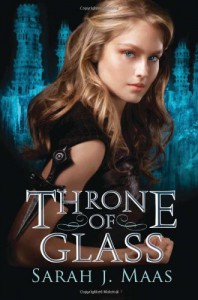
Throne of Glass
What is there to like?
▪ A great strong female friendship!
▪ Exploitative imperialist politics (and resistance to it) as a primary theme.
▪ Despite the weakness of the love triangle plot, it is—mercifully—not really the main point of the book! For the most part, Celaena really is doing her own thing, and has her own motivations, missions, and secrets.
▪ A successful first-novel-of-a-series narrative arc: The story driving this book feels resolved enough by the end to feel like an ending, but it also feels like the first part of a longer story.
What's not to like?
RT @greenbeanblog Teens note to authors "it's really annoying when your characters are all gorgeous."#alamw13 #bfya— Children's Bookshelf (@PWKidsBookshelf) January 28, 2013
RT @greenbeanblog "Most people can't find 1 person to love-why do we keep making it 2?" Teen on frustration w/love triangles. #alamw13 #bfya— Children's Bookshelf (@PWKidsBookshelf) January 28, 2013
The above tweets are from the PW Children's Bookshelf live feed from the ALA Midwinter Conference, and I can't tell you how glad I was to learn that there are actual teen readers who find these points as frustrating as I do...and they apply oh-so-much to this book.
▪ It is downright booooring how beautiful all the characters are in this book. We get it, our protagonist and her two love interests and her princess friend are all super-sexy. Congratulations. Also, how convenient that the baddies are all so physically repugnant. And beyond that, it's disappointing for an otherwise pro-kickass-girl story to reinforce the idea that even if you have another skill (like professional assassinating), the most important thing for young ladies to be is beautiful.
▪ Also boring: the love triangle. Much like Matched, and very UNlike The Hunger Games, there's honestly no apparent reason why it should matter which one the protagonist ends up with—they both seem like perfectly nice dudes; I'm sure she'll be happy with whichever one she picks, and the other one will probably be happy with her equally-beautiful-and-kickass princess friend.
▪ A slow start—the first 100 pages or so felt very much like a pastiche of standard fantasy novels, especially thanks to the names. It even has a Tolkienesque map in the front matter. (Not that all fantasy maps are inherently Tolkienesque—check out Keith Thompson's beautiful illustrations for Leviathan for a gorgeous example of an original—but seriously, the typeface alone on this map invites a negative reaction.)
▪ The reader is easily able to figure out who’s doing the bad stuff earlier than the character does.
▪ Far too much emphasis on describing Celaena’s clothes. Having recently read Shadow and Bone, which had the same problem, I am bothered by this potentially being a trend. It feels intrusive and trivial, and bound to the beautiful-characters problem.
Similar To:
Song of the Lioness series: Alanna: The First Adventure, In the Hand of the Goddess, The Woman Who Rides Like a Man, and Lioness Rampant, Tamora Pierce
The Hunger Games Trilogy, Suzanne Collins
Graceling, Kristin Cashore
What made me pick it up?
A PW Fall 2012 Flying Starts pick.
Overall Recommendation: Recommended

Glory Be

What is there to like?
▪ Well-written prose, with a Southern lilt to the (first-person) narration and dialogue.
▪ Although it is written from a white perspective, I don't think it's a White People Solve Racism story. Racism certainly isn't solved by the end of the book, and the "good" white people aren't magically accepted into the black community. Rather, Glory gets only glimpses of the work that the African-American community is doing for themselves through stories from Emma, the cook.
▪ Glory's preoccupation with the pool being closed for the summer and having her birthday ignored is an honest portrayal of how kids start to learn about and process big problems—that is, when those problems start to infiltrate their own familiar world. This is important, because understanding comes through empathy, and young readers will easily relate to problems they might already understand—Glory's being upset about the pool and her birthday party—and, like Glory, come to understand the bigger, more important problems surrounding it.
▪ The relationships between Glory and her older sister (a teenager starting to grow up and pull away from her little sister) as well as her own best friend (a boy being bullied by his father and older brother in ways Glory doesn't quite understand) are sensitively drawn, and show how people grow and sometimes are torn by different loyalties.
What's not to like?
▪ Although it's not a White People Solve Racism story, it is written from a white perspective, and we do have plenty of cultural texts that portray (even celebrate) the Civil Rights movement through whites' involvement. This book could be a good introduction to the Civil Rights movement for young readers to pick up on their own, then, but it should certainly be followed up with a book that focuses on the African-American experience if they want to learn more.
▪ It does feel a little preachy sometimes, with Lessons too spelled out. For example:
"You know what Jesslyn? When this summer started, I worried that the worst thing would be the pool closing before my birthday and me not having a party. Being twelve is turning out okay after all."
and
"I figured out what's got people...so riled up. It's not just the new people in town. It's things changing so fast that's scaring them. When people get scared, they make up lies . . . And they act mean."
What made me pick it up?
Saw it on the library shelf and remembered that it was on my to-read list, and I want to read more historical/realistic kids' fiction.
Overall Recommendation: Recommended

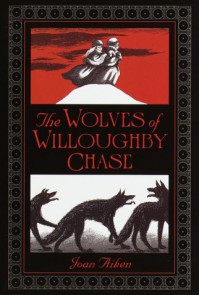
The Wolves of Willoughby Chase (Wolves Chronicles)
It's fascinating how much children's lit has changed over the course of the past century or so, and reading this book for the first time 50 years after it was originally published is an interesting example.
First of all, though, I want to say that the best thing about this is the wolves: There's nothing to spoil except that the wolves are never explained. They're just roaming around, taken for granted. Everybody knows about the wolves, but we never know why they're there. I love this. I love that they're the title of the book but have nothing to do with the story except as a looming, ominous, always-present shadow. I have no idea if they're explained in later books, but the mystery surrounding them in this one is fantastic.
This book feels to me in keeping with the older (earlier 20th century and before) tradition of children's lit: wicked people are thoroughly bad, with no redeeming qualities, and are punished. Good people are hardworking, brave, kind, charitable, and if they are rich they are generous with their wealth and if they are poor they are rewarded by the rich. After the villains' plans are set in motion, the children encounter people so good they border on fairy godmother. Convincing the good adults to save the day from the bad ones is no trouble, and everything is resolved in nigh-miraculous fashion.
What made me pick it up?
It was mentioned to me by a co-worker—who hadn't actually read it either, but we looked it up together and were both sold on the premise and cover, as well as the many accolades.

The Peculiar

What is there to like?
▪ The prologue is an incredible start. Like, say-how-good-it-is-out-loud-as-you're-reading-it good.
▪ Old-fashioned English magic—think 19th-century, Yorkshire-y, iron and salt faery magic—which is so enjoyably dark and creepy. It's not really scary, just...unsettling.
▪ The narration uses quite a bit of 19th-century language style to match, which complements the content to create a mood for the reader.
▪ On the other hand, the language is not so historically stylized that it runs the risk of being off-putting for readers in the intended age range. For the most part, the dialogue isn't much stylized, which should mean a smooth read for middle-grade readers.
▪ The structure, which alternates between Bartholomew Kettle—the titular Peculiar living in the slums—and Arthur Jelliby—a delightfully incompetent upper-class Englishman—until the two characters converge, is effective world-building, as it provides more depth, portraying both sides of the human/faery class divide.
▪ The poverty in which Bartholomew and Hettie live rings historically true (if Hettie's checkered handkerchief doesn't get to you, you're one hard-hearted villain). Compounded by his marginal status as a neither-here-nor-there Peculiar, this makes Bartholomew's sense of abandonment by the world and his wishes for a less lonely life heartbreaking. And makes his bravery for his sister all the more powerful.
What's not to like?
It loses a bit of steam towards the end. Surprising, given that the end is the climax. But the strength of this book was, I thought, in the strangeness of details, rather than the action of the plot. And the end of the book is where it's most about action.
Similar To:
Stardust, Neil Gaiman (guys, I know)
The Spiderwick Chronicles, Holly Black and Tony DiTerlizzi
The Ladies of Grace Adieu, Susanna Clarke (I'm inclined to list that "other" Susanna Clarke book here, but figured LoGA was a more appropriate comparison simply for length's sake. Still, if you're an adult reader, you probably can't go wrong with Jonathan Strange & Mr Norrell.)
What made me pick it up?
It was a PW Fall 2012 Flying Starts pick.

The Diviners
I'm debating between 2 and 3 stars. I finished reading it a couple of weeks ago and in that time still have not been able to figure out what to say about it, other than that I read it. Then I saw the closing sentences in this review: "Bray empties a wealth of topics into her complicated narrative—labor reform, a steampunkish robotics experiment, flapper culture, religious zealotry—but her trademark humor is less apparent. The large cast...ensures there’s plenty to write about in the sequels." And I think that pretty much captures it, not-really-flattering-tone and all. The jazz slang is fun. The characters are pretty flat, defined by a) their type (The Ziegfield Girl. The Harlem Poet. The Rakish Pickpocket. The Eccentric Uncle. The Quiet Friend. The Creepy Old Ladies.) and b) whatever their special gift is, rather than by personality. And it does feel as though it has all these elements dumped into it simply for the sake of More Stuff to Write about Later.

The Miseducation of Cameron Post

What is there to like?
▪ danforth is excellent at creating feelings and atmosphere—hot, small-town Montana summers; intense, guilty crushes; the well-meaning but destructive, and often desperate, born-again Christians. This is such a central part of being a teenager—feeling everything so much more intensely than you ever have before, and heightened awareness of it—that it’s a major achievement for a YA novel, and I mean that as strong praise.
▪ Superb prose style, not only in the descriptions that create the above-mentioned atmosphere, but in the rhythm and realism of the dialogue, and in casual turns of phrases like “death casseroles” (Cameron’s characterization of the food brought over by neighbors in the wake of her parents’ death).
What's not to like?
It does, I feel, exhibit some of the weaknesses I’ve come to associate with “MFA style” adult fiction. I have to abandon all pretense of objectivity here, because the qualities I think of as weaknesses are certainly not viewed that way by everyone, or even the majority of readers.
▪ One, this isn’t a plot novel, but rather an experiences novel. Life isn’t plot-driven, so it is more true-to-life in that sense, and the novel ends on a note of potential, rather than one of finality. Not necessarily a negative point, but readers more accustomed to a narrative arc, or even resolutions to what seem like clearly intended plotline departure points, may come away unsatisfied.
▪ AND YET, despite its “true-to-life-ness” in its lack of a set narrative, there are some almost ridiculously overdetermined elements: actual. flashes. of lightning. when Cameron, Adam, and Jane are planning their escape from camp, for example, and Aunt Ruth’s tumors, and the Quake Lake journey. Rather heavy-handed touches, I thought, presumably for the purpose of adding literary weight.
What made me pick it up?
I saw it on the library shelf and remembered that it was on my to-read list because of PW’s Spring 2012 Flying Starts, and I thought I should read a realistic/“issues” book instead of my usual fantasy/sci-fi.
Similar to:
I don't know; I don't usually read this kind of book! Suggestions?
Overall Recommendation: Highly Recommended
(I’m actually rating and recommending this a notch above what I want to, because my “problems” with it are really personal preferences. So if you’re an actual real friend of mine looking for a recommendation based on our mutual interests, this might be misleading. Or, you might like to try something different, too.)

The Book Thief
What is there to like?
▪ It’s a story about the importance of telling and reading stories. Liesel and Max Vandenburg use reading to get themselves through their darker days, Liesel and her foster father read together, Liesel and the mayor’s wife come together through a mutual love of books, Liesel reads to the townspeople as they huddle together during the bomb raids. Perhaps especially important in stories about war and The Holocaust—events which, more than so many other things, call for two of storytelling's most important functions: memory and empathy.
▪ Rudy Steiner, Rudy Steiner, Rudy Steiner. Liesel’s best friend and partner in troublemaking, brave boy, full of light. The tragedy of a young boy’s death in war is something easily acknowledged, but the fact of it—robbing him, Liesel, the world, of his bright, bright future—wouldn’t hurt so deeply if Rudy weren’t someone to love so completely. Heartbreaking.
▪ Hans Hubermann, Liesel’s foster father: a kind man who keeps his promises and doesn’t know what to do in the face of the tidal wave of Nazi Germany and the war. Again, heartbreaking as a symbol of the real-life men and women of Germany in the 1930s/40s.
▪ Not everybody in the town is a nice person, in the normal way that not everyone is nice. This is important to show—war doesn’t care how nice people are.
▪ Some standout poetic sentences and imaginative descriptions throughout.
▪ The narration by Death offers the opportunity for some interesting reflections and poignant moments of death in wartime and in peace.
What's not to like?
▪ Extremely irritating stylistic choice of what other reviewers have called interjections. I might call them interruptions. Whatever they are, they feel extremely gimmicky—except it’s not clear what this gimmick is supposed to accomplish, which makes it all the more puzzling and intrusive.
▪ It is difficult to care, particularly, about Liesel—this must be the main problem with the book. The narrative is somewhat patchwork, containing many vignettes that occur either during or prior to Liesel’s own timeline, many of which are beautiful or sad or true-seeming. However, Liesel feels like little more than a catalyst for all the interesting things that happen all around her. As the titular character, the book thief should be the one the readers are most invested in, but it seems impossible to get a sense of who she really is—which is thrown into even sharper relief by the captivating personalities of Rudy Steiner, Hans Hubermann, and other townspeople. As a result, the book is missing a heart, which made it difficult for me to love it.
What made me pick it up?
The title; seemingly universal praise; it was continuously on the bestseller list since long before I even paid any attention to bestseller lists.
Other books to try:
The Berlin Boxing Club, Robert Sharenow—for a WWII-Germany story with a boy protagonist
Number the Stars, Lois Lowry—a novel about a family hiding a Jewish friend during the Holocaust
Code Name Verity, Elizabeth Wein—WWII novel with female protagonists
Inkheart, Cornelia Funke—for booklovers
Overall Recommendation: Recommended.
 1
1

The Hero's Guide to Saving Your Kingdom
What’s it about?
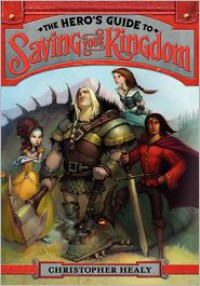
As opposed to the usual spin on fairy tale retellings, this book picks up during the after in “Happily Ever After.” Princes Frederic, Gustav, Liam, and Duncan find that they have all become the collective Prince Charming in ballads. Meanwhile, their rescued princesses (Cinderella, Rapunzel, Sleeping Beauty, and Snow White, respectively) all find themselves disappointed by their new royal beaux and the lives they are expected to lead. When the princesses decide to take control of their lives and make themselves happy, the princes set out to prove themselves worthy not only of the ladies’ affections, but of their own self-respect (and, along the way, recognition as individuals).
What is there to like?
Funny and smartly told, the story’s underlying messages are about loyalty, friendship, and appreciating individual strengths—and, refreshingly, “walks the walk” with characters who can be sympathetic even when occasionally unlikeable. Does credit to young readers with villains who aren’t easily fooled (readers should especially like Deeb Rauber, The Bandit King). With strong role models for boys and girls, this book should appeal to both.
What’s not to like?
?
What made me pick it up?
This article from Publishers Weekly, in which the author is quoted: “…while [Healy] would often commiserate with other parents who were troubled by archetypical images of passive princesses, he was also perturbed by the vacuous nature of Prince Charming in fairy tales like Snow White, Sleeping Beauty, Rapunzel, and Cinderella. ‘He’s so inconsequential,’ Healy says. ‘He’s presented as the ideal man, but he has no personality.’ If princesses are going to fall in love with princes, he continues, then ‘shouldn’t we care about who these men are?’”
Overall Recommendation: Highly Recommended

Seraphina

What is there to like?
▪ Seraphina is a likeable heroine: brave, independent-minded, and compassionate--but not so much so that she seems false.
▪ In so many stories with a female protagonist and a romantic rival, the "competition" is petty, unkind, easily dismissed. But Glisselda holds her own as smart, strong, and willing to learn, and is a genuine friend to Seraphina. I have my suspicions about how this will be resolved without serious harm to either side, but I think it's wonderful for women and girls to have a fair and humanizing portrayal of this kind of female relationship, rather than pitting the two against each other.
▪ The society Hartman has created, including prejudices, political dynamics between Goredd and Tanamoot, and social castes have satisfying depth and subtlety. Answers aren't easy, but this layering makes them seem worth pursuing.
▪ Likewise, the humans' and dragons' difficulty in understanding each other, simultaneous with their reciprocal fascination, is not only believable and "true" in the context of the story, but is the kind of exploration of the attractive and repellent power of differences and commonalities that makes literature--and YA lit in particular--important.
▪ Seraphina and her love interest seem well-matched; he makes a worthy object of her affection as shown through his actions and character, but neither is he a two-dimensional Prince Charming character.
▪ People of different races and orientations are included.
What's not to like?
▪ The book uses the "psychic gifts" trope, which I find to be rather tiresome/clichéd, and which I personally tend to read as a crutch that authors use to manufacture situations and relationships that would otherwise be unbelievable--or just take longer.
▪ Seraphina is brave, but it doesn't seem believable that so many people would automatically put their faith in her as a leader, given her personality (see above criticism of "psychic gifts").
▪ People talk about "princess fatigue"--isn't it time to rethink the prince-as-love-interest as well? Kiggs is admirable, but still...
▪ Goredd's religious system is central to its culture, but seems rather thinly developed. This is perhaps intended to create some suspense for the next book(s), but it does feel either insufficient or deliberately obfuscated at times. (On the other hand, perhaps it only seems so in comparison to the detailed facets of the culture that Hartman has created.)
Similar To:
Dragonsong, Dragonsinger, Dragondrums, Anne McCaffrey
Fly By Night, Frances Hardinge
Graceling, Kristin Cashore
What made me pick it up?
Lovely cover design and a rave review from a youth services librarian friend.
Overall Recommendation: Highly Recommended

Gideon the Cutpurse (Gideon Trilogy)
 I liked the incorporation of historical details, and going back and forth between past and present. The plot felt slow to me; the characters just OK. The main problem, I think, is the inconsistency in credulity of the characters belonging to 1763. I'm not really feeling compelled to read part two, but I have it so I probably will.

The Raven Boys

If I had read this at the age that this book is actually written for, I'm not sure I wouldn't love it to pieces. There are a number of aspects I'm sure teenage me would be swooning over. These days, I tend to read YA fiction with female protagonists through a what-is-this-doing-for-young-women lens, and there's one major element that colors the whole novel just enough that keeps it from being something I'd recommend to other readers.
First, some things I do like: the mother/daughter relationship, the inclusion of both female relationships (Blue's family) and male relationships (the raven boys and their families), themes of class disparity and family dysfunction, the fact that although most of the main characters are recognizable "types," they also seem genuine (aren't we all, I guess), Blue's inclusion as a full participating member of the boys' group, and the Greek tragedy-esque element of inescapable destiny.
But.
Blue's entire raison d'être in this novel is driven by the prophecy that she will kill her true love. It's the opening line. It's the raison d'être for the whole book, it seems. Every action Blue takes or doesn't take in her relationships with the raven boys is shaped by her expectation that THIS COULD BE THE ONE, so a) better rein in that latent potential and keep pure, and b) she can't relate to them, think about them, or connect to them on any other personal level. You guys, I'm so. tired of this. Why can't women have bigger, more adventurous destinies? I want more for the young women that young women read about.


